
Working along a roadside can present many challenges for contractors. It is ideal if jobs can get done on time and without issues. Sometimes, however, the job itself isn’t the only thing workers have to worry about as traffic zips past.
It’s safe to say drivers are less attentive these days with so many distractions: changing the radio station, making calls, fidgeting on their phone or even texting — which in most states is illegal.
“A driver being distracted is always an issue,” says George Kennedy, the vice president of safety for the National Utility Contractors Association. “You get a salesman on the phone or some idiot texting, then you’ve got a problem. There’s always still a certain amount of reaction time.”
ACCIDENTS WILL HAPPEN
According to the U.S. Department of Transportation, there were 5,419,345 roadway crashes in 2010, and 87,606 of those happened in work zones. So only 1.6 percent of crashes occurred in work zones. Of those work zone crashes, 576 (0.6 percent) were fatal.
By comparison, there were 609 work zone deaths in 2012. Texas accounted for the highest figure at 125 and California was a distant second at 67. Alaska, District of Columbia, New Hampshire, Rhode Island and Wyoming all remarkably didn’t have any fatalities in work zones.
Fatal occupational injuries at road construction sites have fluctuated in the last decade. In 2013, there were 105 deaths compared to 133 the previous year, according to the Bureau of Labor Statistics. From 2003-13, there were on average 120.2 fatal occupational injuries.
PROPER WORK ATTIRE
With the possibility of a work zone crash, contractors need to be aware of the dangers of a roadside job and how they can stay safe. Being prepared is half the battle.
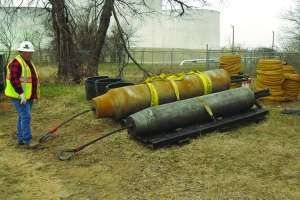
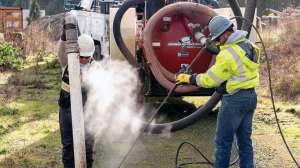
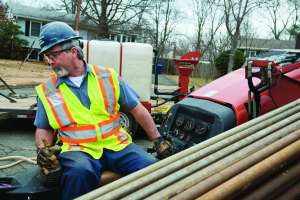
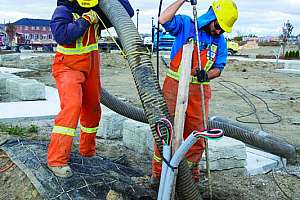
On site, workers should wear hard hats, safety glasses and high-visibility clothing — in the form of yellow, orange or yellow-green vests or jackets — so they can be seen easily by drivers. Most importantly, workers need to be in compliance with the Department of Transportation’s Manual of Uniform Traffic Control Devices (MUTCD). Some states require certain on-site attire, so workers have to make sure they are aware of the laws.
AN ESCAPE ROUTE
Safety begins immediately when the worker arrives on the job site. Contractors should park in a designated area and be wearing the high-visibility clothing when they leave their vehicle.
Kennedy advises that workers should assess the work site right away and formulate a plan in case something goes awry.
“When you’re working near the road, you should try to avoid turning your back to traffic and know where you’re going to run or escape to if something goes wrong,” Kennedy says. “Try not to put yourself into a situation where you’re blocked in traffic. We just tell people to have an escape route.”
SIGNS AND BARRICADES
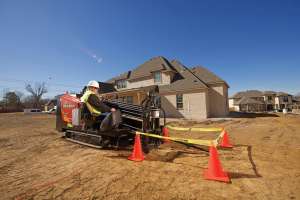
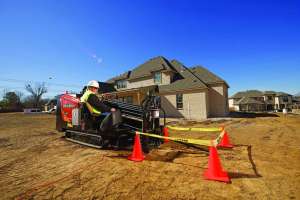
Surrounding the working site, there should be plenty of signage and appropriate lighting if the project is being conducted at night or during low-light conditions. Also, there should be plenty of barriers between the workers and the oncoming traffic. Simple delineators can be used such as cones, orange poles or barrels.
“The contractors should have a work zone plan in terms of what kind of barricades they’re going to put up, what signs they’re going to put up, whether they’re going to use a flagger or a portable traffic light,” Kennedy says. “Many states require a police officer at the job site along the road, so they hire off-duty cops to do that. Controlling speed and setting it at a reasonable limit is important.”
On higher-speed roads, concrete or water-filled plastic jersey barriers should be utilized. The more cones and warning signs allow drivers to be aware of contractors at work. It also prepares the drivers to be ready to slow down and provides more time to react to what’s ahead of them.
BEING INFORMED
“The bottom line is obviously the faster the traffic is going, the faster it can reach the job site,” Kennedy says. “If you get a vehicle moving along at 60 miles per hour, it’s actually traveling 18 feet per second, so in a couple of seconds it might take a person to respond to all of a sudden coming around a curve or something and seeing a work zone. That couple of seconds means they could go a couple hundred feet before they even get to the brake.”
Most veteran contractors of roadside work know what to expect when on the job site. Younger, less-experienced contractors need to be well-schooled these days.
“Realistically, a lot of these workers are new, they’re young and they may not be informed,” Kennedy says. “Experience definitely plays a part in it. The main thing is following the requirements of the MUTCD.”
Continue reading for free