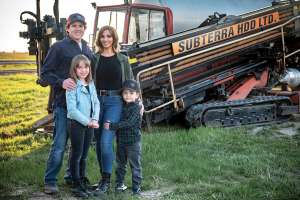
Young owners and a young company. Yet Subterra Horizontal Directional Drilling Ltd. is experiencing the kinds of success older hands might envy. How? Subterra owner Brit Chevrier attributes it to fundamentals that sound like they come from a small-business manual.
“We have low overhead and are highly efficient,” says Brit Chevrier. “And we know what we’re doing. Our knowledge base is strong.” Consequently, the small Canadian company is efficiently and confidently operating across the entire western tier of provinces — Manitoba, Saskatchewan, Alberta and British Columbia.
Brit Chevrier and her husband Zach are Saskatchewan natives. Brit met her future husband when she was 12 years old and accompanied her family from southern Saskatchewan to a lake resort in the northern part of the province. There she met a boy her age, Zach, whose parents operated the resort.
Just over 20 years later, the Chevriers are partners in marriage and in business. The entrepreneurial values to which Zach Chevrier was exposed as a youth he evidently instilled in his wife. “Zach and I always talked about one day owning our own business,” Brit says. “We always had ideas about what we would try out.”
Today, the fledgling company is well beyond a try-out stage. Five years after Subterra HDD was launched, the Bethune, Saskatchewan, firm is busy servicing a wide and diverse range of industrial clients — oil and gas, water and sewer, wind and solar and electric — as well as institutional and municipal accounts. In the last year, the company has seen a surge in telecommunications jobs.
And reviews of the work are good! “We’ve received nothing but positive feedback,” says Zach. “I think word-of-mouth recommendations have helped get our name out there and we’re starting to get repeat clients.” This is called momentum.
SLOW AND STEADY GROWTH
When Zach was a teenager, he, his father, and his brother operated a small sand and gravel business and Zach discovered he really liked the work. He subsequently labored on oil rigs — learning about downhole drilling — and then worked for a builder that had begun dabbling in horizontal directional drilling. From that introduction, Zach moved on to another company where he superintended drilling crews operating HDD equipment rated up to 100,000 pounds.
Unfortunately, his career trajectory was interrupted at that point. The construction company abruptly shut down its directional drilling unit, leaving Zach without a job. He searched out other construction work. “Zach has always had an incredible work ethic,” says his wife — but satisfaction eluded him.
Then fate intervened when he and his father saw a sale ad for a used HDD machine. They began to speculate.
“I bet that drill will go pretty cheap,” Brit recalls Zach saying in the ensuing discussion. “Things started from there.” Eventually, the machine purchase was made and Subterra HDD was built around it.
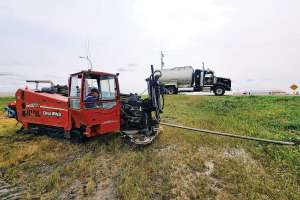
The drill is a 2009 rubber-tracked Ditch Witch JT4020 Mach 1. The 190 hp machine is a midsize piece of drilling equipment, a capacity that has turned out to be a good fit for the company, according to Brit. “Because of its size, we can squeeze into some congested job sites, and it gives us the ability to work for a multitude of industries. Its size has been more of an advantage than a disadvantage.”
The 4020 is capable of drilling anywhere from 160 feet to 1,600 feet and pulling back 40,000 pounds of reamer or pipe string. The unit can drill shorter distances, of course, and Subterra projects longer than that are undertaken in increments.
Subterra uses TriHawk bits and dirt bit adaptors to worm through a variety of soils to targeted exit points. Given the four-province spread of their service area, they have encountered about every type of ground conditions. “We’ve worked in rocky areas and areas with a lot of silty sand and places with gumbo clay,” Zach says. “And the conditions will change within very close distances.”
To keep an eye on the progress of the drill head, the company unpacks its DigiTrak F5 receiver unit. It boasts five frequencies and can find a drill head up to 80 feet underground, sparking transmission of data that keeps the HDD operator on track.
“We have used other locating systems and they all seem great in their own way, but the DigiTrak is very user-friendly,” says Brit. “Zach has trained me on it, and I found it pretty easy to use. The signal strength is amazing. We’ve just no reason to switch to another brand.”
Zach fabricated an 1,800-gallon mud tank for the 350-gpm pump that delivers all-important mud for cooling and lubricating the head and removing cuttings. A more winterized unit for winter work — this is Canada, after all — will be acquired at some point but, for now, “it works great,” says the company owner.
Moving heavy auxiliary pieces of equipment on Subterra drill job sites was a matter of subcontracting for someone to deliver and offload the equipment. No longer. The company recently invested in a 2009 Peterbilt boom truck. “It simplified our lives a bit. Obviously, it was something we were really lacking. It eliminates our downtime waiting for someone to do a box change,” says Brit.
The company machinery is hitting on all cylinders and, for now, the Chevriers are satisfied with what’s in their equipment yard. “We looked at a brand-new machine a little while ago and were not taken aback by the newest technology,” says the owner. “They have upgraded a few things and have way better sight lines.” But they resisted the temptation to buy.
ALL ABOUT SAFETY
“Zero Incidents Require 100% Commitment.” The website declaration is not pure marketing. Subterra HDD backs up its slogan with real-time decision-making to have a safe working environment. Part of the emphasis stems from Brit’s background as a certified occupational health and safety practitioner. “That schooling gave me a leg up on that side of the business. I’ve developed a passion for all things safety related.”
Proof of the company’s effort is that, in its first year of operation, Subterra was accorded a Certificate of Recognition, or COR, from the Saskatchewan Construction Safety Association. The COR program is a Canadian effort to set standards and certify that companies are working to prevent and mitigate accidents and injuries. Training of company employees is involved in the program along with periodic inspections.
“We had to develop our safety program from scratch,” says Brit. “We’ve continued to shape our safety culture into one that speaks both to us and to our clients. It’s grown organically from there.”
How does it work exactly? “We find that accidents occur most often when people are rushing, so we always try to mitigate that by being as organized as possible,” she says. Another example: One reason the company limits itself to 1,600-foot maximum drills is the safety factor. “To go longer than that puts a great deal of pressure on our equipment, so on the safety side of things, it is not an advantage to drill farther.”
The bottom line is that Subterra Horizontal Directional Drilling has been injury- and accident-free during its first five years of existence. Perhaps the closest the business came to an accident was when Zach was driving back from a job and the driver’s-side front tire blew apart while the truck traveled at highway speed.
“It was an act-of-God kind of thing, that is, there was no root cause. It turned out OK, but we’re always on alert for such things,” the owner says. Adds her husband: “Pre-trip inspections are wildly important.”
Educating employees about safety is easy since company personnel number precisely three. Besides the owner and her husband, the only other employee is Jim Winthrop. He and Zach worked together at the company that shut down its HDD division. When Subterra was being formed, Winthrop became part of the company story.
“We are very lucky to have him,” says the owner. “He is so knowledgeable and level-headed. This work can be high-stress and Jim takes things as they come.”
A WINNING FORMULA
The small Subterra team is functioning at a high level. Brit has drawn upon her previous business administration experience to establish an office where the back end of things is efficiently handled. Because she has artistic talent — including in photography — she has developed expertise in marketing design and social media advertising.
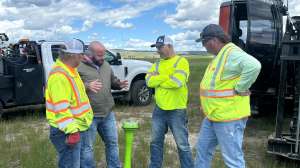
Meanwhile, her husband and Winthrop are just as efficient and effective in the field. “Zach puts a lot of work and thinking into pre-planning and site visits. He sees that we always work within our capabilities so we can best meet our clients’ needs.”
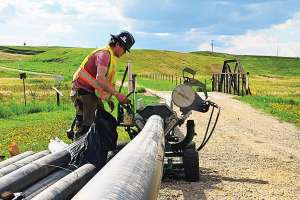
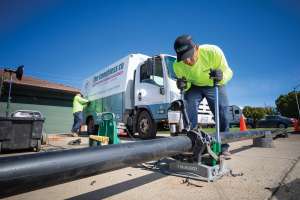
This caution doesn’t mean they aren’t willing to push the envelope in bidding jobs. In November 2020, the company contracted to drill and insert a new culvert near a deteriorating one that was contributing to roadway washouts. The two-person crew drilled a 260-foot-long, 32-inch tunnel beneath the road and supplied, fused and pulled in a 30-inch high-density polyethylene pipe.
“That was kind of neat,” Brit says. “It was pretty big pipe for our drill. People in the industry have asked Zach, ‘How did you manage that with a 40,000-pound drill?’”
A willingness to undertake difficult tasks is part of the company’s DNA. “We’re always up for a challenge and tackle a lot of projects that other outfits might shy away from,” Zach says. “That sets us apart from our competition and we value that as a company.”
Positive comments are the rule after projects with most of the feedback being that they are very efficient and very organized. “We try to keep our prices competitive — without undercutting prices in the industry that reflect the value of the specialized service we’re offering — and we can do that because of our low overhead,” Brit says.
It all sounds like a winning formula and the owner and her husband-partner are hoping it leads to company growth. The immediate goal is to stay focused and eventually pick up a second HDD unit so the company can serve multiple clients at the same time.
“I don’t see us expanding into the rest of Canada, but crazier things have happened,” Brit says. “We would love the opportunity to take on more work, employ more people, and make a name for ourselves. Growth is a gradual process, and we respect that process. We feel confident that the future will remain bright for Subterra.”