
Forget about science fiction: Artificial intelligence is a reality making its way into all aspects of modern life. This includes trenchless technology projects, says Laurie Perkins, project engineer and NASSCO’s training director.
“It’s a total reality. Artificial intelligence is already here, and folks are already using it for different kinds of projects,” she says. “It depends on the type of project and what the goal is, as to whether the application of what we refer to as ‘Automatic Defect Recognition’ in the AI arena will work for a project. NASSCO has codes that identify types of defects; for example, a hole or a crack or a fracture or roots. What artificial intelligence is doing — through the use of automatic defect recognition — is teaching machines the process of identifying what a human would identify similarly as a crack or a fracture.”
HOW IT WORKS
Despite their appearance of self-awareness, AI-enabled machines are simply incredibly powerful data processors that have to be ‘taught’ every element of the jobs they have to perform, in order to then do the jobs under their own direction. In the case of ADR, the AI-based system has to learn to associate specific codes with specific types of photos, again and again and again.
“This is how the AI machines are taught to then correctly call a hole a hole and a root a root,” says Perkins.
Once an AI-enabled machine has been trained to perform ADR, it is ready to review images from pipe inspections. To put it mildly, there’s a lot of work for such a machine to do.
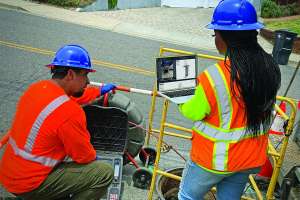
“We have over 800,000 miles of mainline sewers and 500,000 miles of lateral pipelines,” Perkins says. “All of these pipes require routine inspections. And then some of them require emergency inspections, because something’s gone wrong and we need to get a camera into the pipe to figure out if there’s a blockage of some kind or a collapse.”
To sort through and assess the raw images/videos, an AI-enabled machine uses a software-based approach known as Advanced Analytical Processes. AAP involves analyzing the data and cross-referencing with data from other sources, to assess what is being seen in the inspection images/videos and determine which potential defects should be forwarded to human inspectors.
NOT REPLACING HUMANS
There is no doubt that an AI-enabled machine can go through pipe inspection images/videos much faster than a human can, and — with the right training — achieve comparable levels of accuracy in assessing what it “sees.” Yet the role of AI-enabled ADR is not to replace human pipe inspectors, but rather to filter the images so that only the ones that show problems are sent to people for a closer look.
“The ADR process allows us to process inspection data faster, but it never takes the human out of the loop,” explained Perkins. “It still takes a human to slow the pipe inspection video down and look at the data more carefully and decide maybe how to rehabilitate the pipe in question.”
No matter how accurate AI-enabled ADR machines prove to be, there will always be a need for human experts to review their conclusions and validate them — or not. And that’s the point: “At NASSCO, we want to continue to educate people that yes, AI-enabled ADR can move through data faster, and it’s going to be very powerful in catching things before they fail,” Perkins says.
“But everything still requires some validation, and we don’t want our wonderful operators that are certified to do this work thinking that ‘the machine’s going to take over’ because it can’t. For instance, today doctors use artificial intelligence and ADR for looking at X-rays. That system may give them a cursory recommendation on what’s wrong with a human, but then the doctor has to look at those results and make sure that they’re validated and make sense. And that is the same in our industry.”
AI POSSIBILITIES
Clearly, AI-enabled machines have lots to offer anyone who owns, operates, and services pipes.
“A lot of municipalities have tons of video data sitting on the shelf from 10 to 15 years’ worth of inspections, and they’ve never had time to do anything with them,” says Perkins. “These videos can now be reviewed using ADR, to truly benchmark a sewer system and figure out ‘Do I need to make repairs in two years, or am I still 10 years out?’”
AI-enabled ADR machines can also be used to train human inspectors by presenting them with validated examples from the ADR system to teach them what different kinds of defects look like.
“Another way folks are using AI, and this is a really important one for safety, is to identify cross bores,” Perkins says. “Cross bores can be caused from third-party utilities like fiber optics or gas mains that may have been directionally drilled through an existing home lateral service or a mainline pipe. Today, we can use an ADR approach to find those cross bores and do something about them quicker.”
INCORPORATING AI INTO PROJECT DOCUMENTATION
As AI moves from being an innovation to an integral element of pipe inspection, NASSCO is taking steps to ensure its proper place in project documentation. “With the new release of our Version 8 Pipeline Assessment Certification Program, which came out in January 2024, we have implemented the ability for program operators to document when they’re using ADR and how they’re using it,” says Perkins. “Is it training? Is it legacy data? Is it a brand new coding inspection? Are they looking for cross bores? So in our program where we fill out fields as we’re collecting data, the fields have been modified so that we can account for this new technology.”
In addition, NASSCO has drafted several articles to educate municipalities about AI, ADR and AAP. “The people in those jobs may not be up-to-date about AI, so we are trying to help them,” Perkins says. “Meanwhile, NASSCO has an ongoing ADR workgroup that is staying on top of this technology, and is setting and achieving goals on a yearly basis.”
All told, AI has found its place in the trenchless industry, both in current applications such as ADR and for other purposes yet to be realized.
“At NASSCO, the subject of artificial intelligence is always on the agenda,” says Perkins. “Our membership wants to learn about it, and we are a good resource for different articles about AI.”
Continue reading for free